
The Asgard SPAC – Space and IOT

The Asgard SPAC focuses on space communication technology

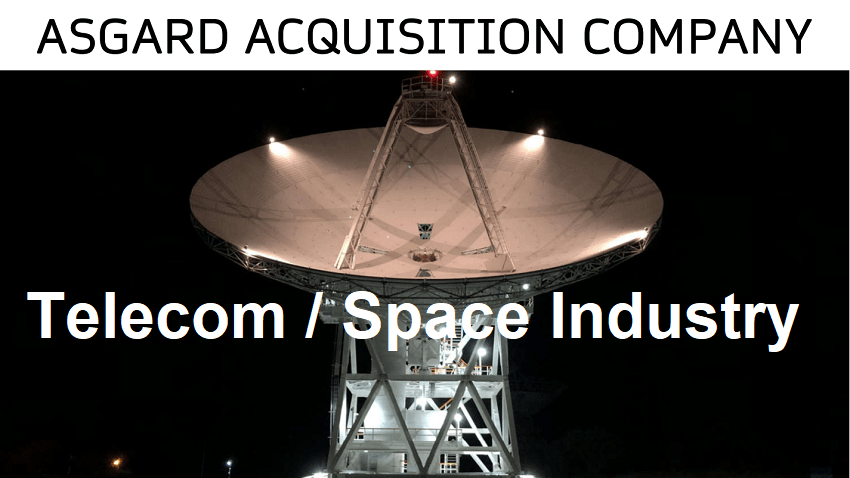
The Asgard Acquisition Company, a SPAC currently preparing for public listing, intends to focus on acquisitions in the area of small satellites and cubesats for telecom services, earth observation, greenhouse gas monitoring, surveillance and for global IOT applications.

Morgan Stanley estimates that the roughly USD $350 Billion global space industry to surge to over USD $1 Trillion by 2040. The Asgard SPAC will be a part of this industry.

The telecommunications industry represents growth, innovation, and disruption for all sectors across the globe.

The COVID-19 pandemic has highlighted the importance of telecom to our lives, highlighted by the massive shift to working from home.

By the end of this decade, 5G could add trillions of dollars to the global economy according to a new report by the McKinsey Global Institute. By 2030, they forecast 5G deployments using millimetre wave spectrum will cover 25% of the global population, at an estimated cost of $700 billion to $900 billion.

The global IoT market size was at $330.6B in 2020. It is expected to reach $875B by 2025, at a CAGR of 27%.

The excellent management team of the Asgard SPAC will be looking at high-tech companies with a positive cash-flow to take the best of it public.

The Asgard SPAC presentation:

SPAC Consultants: Our holistic approach to SPACs

As experienced SPAC consultants or SPAC advisors, we provide our SPAC advisory and project management services to different group of clients related to SPACs.

Our SPAC consulting and project management services are tailor-made for private equity investors who wish to invest in their own SPAC on the pre-IPO stage as so-called SPAC Sponsors, or who prefer to sponsor an existing SPAC project at its pre-IPO stage.

As SPAC consultants, we are designing and structuring SPACs, arranging for S.E.C. approval and listing at Nasdaq or NYSE, organising pre-IPO roadshows, arrange for IPOs and assist in finding acquisition targets as per a SPAC’s acquisition strategy. Our SPAC consultants and advisers are well experienced on all stages and aspects of SPACs.

If you are interested in setting up a SPAC or in participating in an existing SPAC on its pre-IPO stage, we will be happy to arrange an initial Zoom conference to get acquainted, to further elaborate on SPACs and their manifold opportunities, and to discuss with you your SPAC investment and business ideas.

Important note:
SPAC Consultants is not offering and/or providing investment advisory services in the sense of regulated investment advisory services as per respective EU Directives and their implementation into national law of EU Member States. Instead, SPAC Consultants offers SPAC Project Management services and consults regarding the general principles of US SPACs and their business structuring. Any investment, legal and financial advice that may become necessary for possible sponsors and investors at advanced stages will be provided by the network partners of SPAC Consultants.

SPAC Acquisition Target Industries 2020-2021

SPAC Acquisition Target Industries and Sectors H2 2020 and Q1 2021

SPACs are focusing on acquisitions with an above-average growth potential. While acquisitions of tech companies represent the biggest piece of the cake, there is still a healthy diversification seen in the acquisition strategies of SPACs.

This article analyses SPAC acquisition strategy sectors and sub-sectors of SPACs that launched their IPO during the second half of 2020 and during the first quarter of 2021.

SPAC Acquisition Target Industries

A total of 295 SPACs floated their IPO during the first quarter of 2021, compared with 128 SPACs IPOs during the second half of 2020. To our opinion, in 2021, we will see a total of around 800 – 900 SPAC IPOs in the United States, plus a very few in Europe and even less in Asia. But let us see how the market will develop, how some speculative and over-tuned SPACs will influence the market, and what regulation changes might come up to tame speculators and other wrongdoers. Whatever this year will show, one thing is clear: SPACs are here to stay. At least as long as we continue with quantitative easing, low or negative interest rate and general economic uncertainty. And that means long years to go.

SPAC Acquisition Target Sectors

It is not easy to do a meaningful evaluation and grouping of acquisition target industries, as almost everything today is related to technology. In our evaluation, we put those SPACs into the “Tech” category that explicitly mention in the acquisition strategy “tech company”, “biotech”, “fintech” etc. Where the acquisition strategy of a SPAC included several criteria, we chose the one which seemed to be the main criteria, or which appeared as the most specific area.

SPAC Acquisition Target Industries and Sectors 2020 and 2021

While the share of tech companies was 31.25% of all SPACs that launched their IPO in H2 2020 (40 of 128 SPACs), tech companies’ share increased to 46.78% in Q1 2021 (138 of 295 SPACs). It seems that the SPAC frenzy in 2021 did also lead to a frenzy in hunting for even higher growth potential. We did already witness some exaggeration in target company valuations by SPACs, when mature startups with no or very little cashflow were appreciated at a billion dollar and more. Such “hyper-valuations” will make it difficult for the target company to deliver accordingly, once taken public by through merger with a special-acquisition company.

The second largest group of acquisition target industries or sectors in both H2 2020 and Q1 2021 comprises sectors that we commonly names as “Social”. This group includes acquisition target sub-sectors that have a focus on dealing with people of having a direct impact on people through technology, such as “Consumer, Consumer Goods”, “Energy”, “ESG” (meaning target companies with a focus on Environmental, Social, and Corporate Governance, which could be from any industry), “Financial Services “, “Hospitality, Leisure, Travel, Dining, Gaming”, “Mobility” and “Sustainability”.

This group of target industries had a share of 26.56% in H2 2020 (34 of 128 SPACs), which then sized down to 19.32% in Q1 2021 (57 of 295 SPACs).

The third largest share in both H2 2020 and in Q1 2021 goes to SPACs that did define their acquisition strategy in their Registration Statement (S-1) filed with the Security Exchange Commission in a very general and broad way not allowing a conclusion that would lead to any specific industries. The share of the group “General, Broad Strategy” is 17.19% in H2 2020 (22 of 128 SPACs) and, almost unchanged, 18.31% in Q1 2021 (54 of 295 SPACs).

The sector group “Others” includes all those sectors with a share of 2% or less.


SPAC Acquisition Target Sub-Sectors
SPAC Acquisition Target Sub-Industries and Sub-Sectors 2020 and 2021

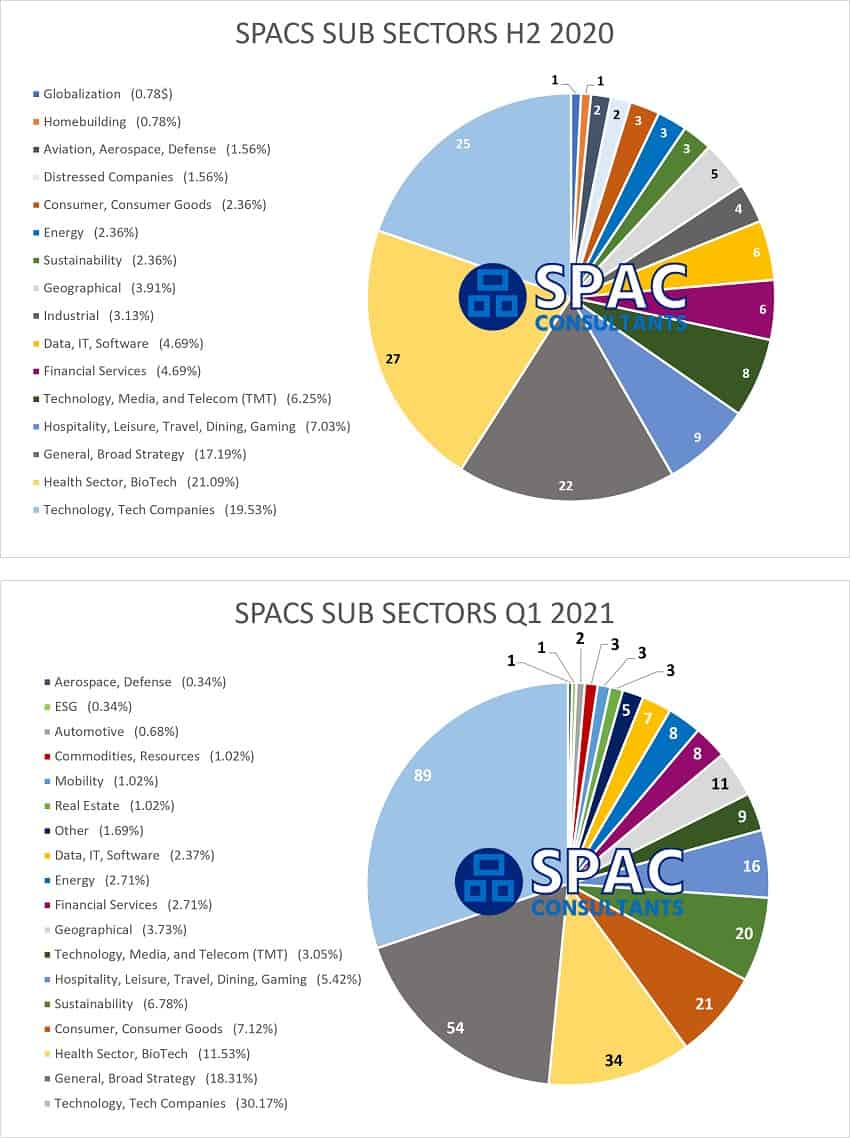
As perhaps to be expected, technology and tech companies take a big piece of the cake, namely 19.53% in in H2 2020 (25 of 128 SPACs) and 30.17% in Q1 2021 (89 of 295 SPACs).

However, we separated Biotech companies. Although biotech companies are still tech companies, they form the largest part of tech companies in general and thus we gave them their own piece of the cake. The sub-sector “Health Sector, Biotech” does also include a few acquisition strategies that focus on health care. During H2 2020, the sub-sector health and biotech took a share of 21.09% (27 of 128 SPACs), and in Q1 2021 a share of 11.53% (34 of 295 SPACs).

FinTech companies in the focus of SPAC acquisition strategies, which are not mentioned separately in our evaluation, took a share of 4.65% with just 6 SPACs in H2 2020, and a share of 6.05% with 18 SPACs in Q1 2020. This just mentioned because we often hear that Fintechs are the darling of SPACs.

We actually love to see that increase of the focus on Fintechs and would love to see an increase in SPACs focusing on financial services. Fintechs are the technologies that will disrupt financial services, and re-organisation of financial services is a way of making banking easier for everybody, and a way of more banking democracy, providing better banking access to the under-banked.

The increase of SPACs with an acquisition strategy focusing on consumers and consumer goods is interesting, to our opinion. While 2.36% of the SPACs during H2 2020 focused on this topic, we see 7.12% of the SPACs in Q1 2021. These SPACs will focus on consumer behaviour, related mass data and its utilisation for the refinement of marketing strategies and tools.

Interesting is also the geographical focus of some SPACs, most of them not even mentioning any specific industry. In 2020, two SPACs mentioned in their acquisition strategy that they are focusing on Asia, and one SPAC each focuses on Mexico, Brazil, and Europe. In 2021, the geographical distribution was as following: two SPACs focusing on Africa (both with ESG as secondary criterion), one on Asia, one on Brazil, two on China, two on Europe and North America, one on the EMEA region, one on North America, and one SPAC mentioned that it focuses on anywhere outside of the US.

Source of base data for this article: SPAC Insider.

Conclusion

Technology and tech companies are paving the way to our future. The entire tech development is just at its beginning, areas like Mass Data, AI, Fintech, or Biotech, to name a few, will disrupt things as we did them until now (or yesterday) and will form new ways to deal with things, improving our lives. It is therefore only natural that technology and tech companies represent the lion portion of all SPAC IPOs. The expectable growth potential further adds to the interest of SPACs in technology and tech companies.

On the other hand, we love the diversification of SPAC acquisition strategies, allowing companies other than only tech companies to go public and to get access to funds for their projects and ambitions. It is creating hope for our future that topics like Environmental, Social, and Corporate Governance (ESG), Sustainability, Healthy Living and Education took already place among the many focuses of SPAC acquisition strategies.

Never in history have so large private funds been provided to the economy and to companies in such a short period. If not misused but structured and invested professionally, SPACs are and will be one of the driving powers of economic, technologic, and social development.

Shanda Consult has been working with SPACs for many years, and our network of SPAC executives has deep experience in the sector. If you need to learn more about how to successfully use a SPAC structure and perhaps wish to set up your own SPAC, we are here to help.

Please contact us with any questions you may have.

Nicosia, Cyprus, April 02, 2021.

Important note:
SPAC Consultants is not offering and/or providing investment advisory services in the sense of regulated investment advisory services as per respective EU Directives and their implementation into national law of EU Member States. Instead, SPAC Consultants offers SPAC Project Management services and consults regarding the general principles of US SPACs and their business structuring. Any investment, legal and financial advice that may become necessary for possible sponsors and investors at advanced stages will be provided by the network partners of SPAC Consultants.

SPAC Boom Making D&O Insurance More Expensive

SPAC Boom Making D&O Insurance More Expensive, Harder to Obtain

The rise in the popularity of SPACs is striking. 2020 saw the structure used at record levels, and from the looks of it, 2021 may eclipse 2020 based on the number of SPACs as well as the total amount of money raised via SPACs.
While this has shown how attractive SPACs can be as a deal making vehicle, the rapid rise in SPACs has led to a strained marketplace for SPAC Director and Officer (D&O) insurance.

248 SPACs were listed on U.S. Exchanges in 2020, raising more than $80 billion. As a result of this, the niche insurance market for SPAC D&O insurance exploded in popularity, as the flood of new SPACs rushed to buy coverage for their management.

Unlike many kinds of insurance, there isn’t a developed reinsurance market for SPAC D&O insurance. Instead of going to another, generally larger, insurance company and buying insurance to cover the D&O policies that were written, insurers are forced to raise premiums, or cut the amount of coverage that is offered on a gross basis.

In late 2020 the premiums on SPAC D&O insurance rose rapidly. Aon, a major issuer of D&O insurance, told media that in mid 2020 a SPAC could expect to pay around $20,000 per $1,000,000 in D&O coverage. By October of last year, that amount had quintupled to $100,000 per $1,000,000.

The Evolving SPAC D&O Insurance Market

While SPAC D&O insurance is a vital part of any SPAC’s operations, the market for D&O insurance was small prior to the 2020 boom. SPAC D&O insurance is a unique form of coverage, which is part of the reason why there weren’t many companies that were ready to handle the rush to secure relatively huge amounts of SPAC D&O coverage.

A SPAC’s life cycle is spread out over three stages, and each stage requires insurance that is created especially for the company’s executives. In addition to being an area of specialist insurance to begin with, every SPAC may need to create bespoke insurance for its specific fundraising and acquisition strategy.

Small SPAC D&O insurance departments simply weren’t ready to digest the huge influx of new insurance demands, or sort through the executives that were entering the SPAC space. In addition, most SPACs have traditionally sought two years of coverage, which is the maximum amount of time they are allowed to make an acquisition.

In the days before 2020, this time frame was acceptable to insurers, as they had few SPACs to cover. When the rush hit, the additional year of insurance doubled the amount of time that was being asked for when compared to standard D&O insurance plans, which are generally renewed annually.

Yelena Dunaevsky, who is a corporate finance and securities attorney at Woodruff-Sawyer & Co., commented:

When you have such a large influx of SPACs and a limited insurance market that’s able to cover them, you get into your standard supply-and-demand situation where insurers are dictating terms and hiking up prices.”

Added Costs and Coverage Gaps

From the standpoint of the SPAC, the situation was equally challenging, as the companies had to decide on how to deal with the gaps that were emerging in the amount of insurance they were able to secure.

For many SPACs, the only solution was to accept the new cost structure for SPAC D&O insurance, and also work with the smaller amounts of coverage that were on offer. As the amount of total coverage available fell, the price for retention (a deductible) rose.

SPACs may have been expecting to buy $20 million worth of D&O insurance with $1.5 million in retention, but by the end of 2020, many had to deal with an offer of $5 million in coverage with $5 million in retention, and at much higher prices than just a few months earlier.

In some cases SPACs that failed to secure D&O insurance early in their life cycle were forced to delay IPOs, as the needed insurance was far more expensive than was planned for – if it was available in the quantities needed at all.

New Faces in the Game

One aspect of the SPAC D&O insurance equation that may have been a surprise to many of the new companies’ executives is that previous experience in the SPAC sector helps to secure D&O insurance on favorable terms, as insurers are likely to give preference to executives that know their way around a SPAC’s nuances.

Much in the same way that there aren’t many dedicated SPAC D&O insurance operations, there really aren’t many SPAC executives out there with deep knowledge of the company structure, and the potential issues that can arise during the life cycle of a SPAC.

There are numerous aspects of a SPAC that can create the potential for litigation, and experienced SPAC board members and directors need to fully understand the consequences of their actions. Many SPACs have executives that simply lack experience, which makes writing large amounts of D&O insurance a difficult prospect for insurers.

To complicate things further, many execs who have experience in the SPAC sector won’t accept an appointment without good D&O coverage in place, although this may not enter into the thought process of people who are new to the sector, and simply don’t understand the risks of a SPAC.

A Complex Insurance Structure

Insuring SPAC D&Os is actually a very complex process, as specific insurance has to be written for every stage in the SPAC’s life cycle.

According to Woodruff Sawyer, an insurance specialist, SPACs are exposed to five forms of private litigation:

-Plaintiffs can allege liability for damages for material misrepresentations or omissions of facts in the SPAC’s S-1 registration statement.

-Plaintiffs can bring a suit challenging the completeness of the proxy statement filed in connection with the SPAC’s acquisition of an operating company during its de-SPAC transaction.

-Plaintiffs can sue after the merger transaction because they are unhappy with the resulting company, alleging that SPAC shareholders learned of the true nature of the target company only after the merger was completed.

-Plaintiffs can bring a securities class action suit against the newly public operating company after the SPAC combination.

-Directors of a SPAC that purchases a target company which subsequently becomes bankrupt may be sued by the bankrupt company’s creditors.

Given the rush into using SPACs in 2020, and now in 2021, it is easy to see why the SPAC D&O insurance market has been under strain, and also why it has been difficult to scale up coverage to meet the demands of the SPAC boom.

Will the SPAC D&O Insurance Industry Evolve?

Clearly, there is demand for more SPAC D&O insurance, and some insurers think that insurance companies will expand their coverage to meet market demands. However, this may not address some of the underlying issues in the marketplace.

The simple fact is that while SPACs have become popular, the number of experienced SPAC directors and officers hasn’t grown alongside the boom in SPACs. This may prove to be difficult for many of the new SPACs, which will struggle to safely navigate the complex life cycle of the company.

Whether or not the board and directors of a SPAC are experienced may mean the difference between a successful SPAC, or a company that ends up in litigation without adequate insurance to cover the lawsuits that are brought by jilted investors.

Shanda Consult has been working with SPACs for many years, and our network of SPAC executives has deep experience in the sector. If you need to learn more about how to successfully use the SPAC structure, we are here to help.

Please contact us with any questions you may have.

Nicosia, Cyprus, Feb 20, 2021.

Important note:
SPAC Consultants is not offering and/or providing investment advisory services in the sense of regulated investment advisory services as per respective EU Directives and their implementation into national law of EU Member States. Instead, SPAC Consultants offers SPAC Project Management services and consults regarding the general principles of US SPACs and their business structuring. Any investment, legal and financial advice that may become necessary for possible sponsors and investors at advanced stages will be provided by the network partners of SPAC Consultants.

SPAC nedir?

SPAC nedir?

2020’de yıldızı parlayan “Special Purpose Acquisition Companies”, ya da kısacası SPAClar, Türk sermaye piyasası hukukunda "Birleşme Amaçlı Ortaklık" olarak adlandırılmaktadır.

Birleşme Amaçlı Ortaklık, birleşme ve devralma işlemlerinde sermaye piyasalarından finansman sağlamak maksadıyla kurulup payları halka arz edilen bir yatırım aracıdır.

2020 yılında; özellikle ABD borsaları, Nasdaq ve NYSE’de büyük rağbet artışı kaydeden Birleşme Amaçlı Ortaklıkların IPO (Initial Public Offering) yani İlk Halka Arz işlemleri, toplam IPO işlemlerinin yarısından fazlasını oluşturarak en çok tercih edilen IPO yöntemi oldu.

Peki, SPAC nedir?

Bir SPAC,

  • kısmen kaldıraçlı devralma yöntemiyle
  • özel bir şirket satın almak için
  • ilk halka arz yoluyla
  • hızlı ve nispeten düşük masrafla
  • sermaye toplamak amaçlı,
  • borsaya kote edilen bir şirkettir.


SPAC’lara bir araç olarak ilgi gösteren dört kitle mevcuttur:

  1. Bir SPAC’ı kurup ona gerekli yatırım sermayesini sağlayan, SPAC dünyasında “sponsor” olarak adlandırılan yatırımcılar ya da SPAC kurucuları;
  2. Bir SPAC’ın IPO (ilk halka arz) işlemlerinin ilk gününde hisse satın alarak çok ciddi finansman sağlayan (genelde 100 milyon ABD Doları ve üzeri) kurumsal yatırımcılar (emeklilik fonları, ulusal varlık fonları, aile varlık yönetim şirketleri vs);
  3. Küçük yatırımcılar;
  4. Hisselerini, borsaya kayıtlı bir SPAC’la birleştirerek halka arzetmek isteyen özel şirketler.

Yukarıdaki resmi tıklayarak ulașacağınız sunumumuz, yukarıdaki gruplardan üçüncüsü hariç bütün gruplara hitap edip SPAC’lar hakkında  aydınlatıcı bilgi vermektedir.

Hizmet Kapsamımız

SPAC Consultants Wall Street’ten, SPAC konusunda kanıtlanmış performansa sahip doğru insanları bir araya getirir. SPAC’larımızı, müşterilerimizle birlikte ilk başlangıçtan itibaren riskleri ve maliyetleri asgariye indirecek ve performansı azami seviyeye çıkaracak şekilde yapılandırmaktayız.

Bizimle temas kurun ve bütün sorularınıza cevap alınız.


Are SPACs Losing Attractiveness?

Are SPACs Losing Attractiveness? Not Necessarily!

With 182 SPAC IPOs in 2020 (as per Nov 17) and additional 60 SPACs currently in the pre-IPO stage, the US SPAC market boomed as never before.

SPAC IPOs became the new IPO. SPAC IPO proceeds increased tremendously; some SPACs’ IPOs collected more that one bullion US Dollars.

The steep spike of SPACs this year is eventually raising question: Are SPACs losing traction? Have SPACs reached their limit?

Are SPACs losing attractiveness?

Some insiders of the SPAC space even see flashing warning signs of a decline.

In my humble article, I will take up current arguments of concern and will elaborate why SPACs did indeed not lose attractiveness, provided that SPACs are really business-focused, in contrast to speculative SPACs, and that they are excellently structured.

I recently came across a very good article on Bloomberg Law, which analyses the current situation of SPACs and SPAC IPOs. An excellent work, indeed. To be fair, the article does not explicitly say that SPACs are losing attractiveness, but that “Investor hunger for SPACs is hitting limits”.

However, I do not agree with at least some of the conclusions.

The article states at its beginning:

“The insatiable appetite for U.S. SPAC IPOs may finally have reached its limit. It is not that investors have suddenly turned sour on blank-check companies. Rather, broader economic concerns, combined with the investment and insurance industries’ own limits on SPAC exposure, are producing a market pause and a trend toward increasingly discerning investing.”

One argument is: the political environment is not beneficial for SPACs anymore.

“The market experienced volatility jitters in October, reflecting worries about the election and the lack of more Covid-19 relief from Capitol Hill.” Yes, that is true, but it is not specific to SPACs. The nervous up and downs on Wall Street were reflecting – and will continue to do so – a general desperation of small and large investors in respect of trustable investments, accompanied by sudden reverse moves of enormous volumes to settle unbeneficial positions.

There is no plausible reason that psychology-backed volatility would not affect SPAC shares as well.

I agree that the dip of the DraftKings SPAC fell 40% in October, to below $22.5, is not good news for investors who buy and sell shares on Nasdaq. But this is nothing different from any shares publicly traded, be them SPAC shares or not.

It is well worth to note that a “dip” to below $22.5 of a share that was offered for $10 on the IPO, is still an extraordinary gain for both IPO investors and pre-IPO SPAC investors, called SPAC sponsors in the SPAC space.

Finally, snapshots during very volatile markets are never a good idea. Today, Nov 17, 2020, the same share is traded at a price above $45!

Efficacy of the presidential transition, the leadership in the Senate, speculations on pandemic relief support are very temporary phenomena that will continue market volatility, but not the interest of large institutional IPO investors in SPACs. Again, if SPACs are really focused on resilient business acquisitions and have a quality board with the necessary expertise and experience.

Is the pipeline for SPACs really slowing down?

The Bloomberg Law article continues saying “that filings for new SPAC IPOs peaked in September and declined substantially in October. It also reported that roughly 60% of October listings are trading below their offer price, despite the capital raised in public offerings being held in trust. This slump is an indication of nervousness among investors about SPACs’ prospects.”

The information as such is of course true. However, this is not an argument that SPACs lost attractiveness in general.

The majority of SPACs is always trading below their IPO offer price. And that is very natural. SPACs, Special Purpose Acquisition Companies are companies that go public without having any business or assets but an acquisition strategy and a (more or less) convincing board. It is common practice that the offering price is $10 on the day of IPO. It could be $8 or $15 s well, as there is no pricing based on the company’s business, because it has no business. When common shares are then open for trading, traders do buy shares because they wish to participate in a possible spike of share prices, but they are somehow reserved, as they do not know how great an acquisition a SPAC will land. Post-IPO SPAC share prices tend to remain below their offer price but gain momentum when the SPAC board starts publicly communicating its promising path toward a successful acquisition. This shows how important public communication is (not only) for SPACs. Those SPACs that have their shares trading well above the offer price are SPACs with professional market communication, and often SPACs that have prominent figures on their board.

There is one important detail that needs to be mentioned in this context: Rights are back since a few days. Rights mean the right of the investment bank and – in case of execution by the investment bank – the obligation for SPAC sponsors to purchase a certain amount of offered rights to acquire common shares. The price of one right is typically capped at $0.10. Each holder of a right will receive, without any additional payment required, one-twentieth (1/20) of a share of common stock upon consummation of a SPAC’s initial business combination, which means that right holders will get one share for 20 rights, equalling typically to $2.00.

While this is a good opportunity for sponsors and the investment banks to stock up their shareholding after consummation of the initial business combination (acquisition) at a very low price, the purchase of rights by SPAC sponsors demonstrates, to the market and to the institutional IPO investors, the confidence of the SPAC board confidence in its ultimate ability to effect a business combination because the rights will expire worthless if we are unable to consummate a business combination. Furthermore, it potentially prevents the stock market price of SPACs dropping significantly below the offer price, thus providing price stabilisation.

The Bloomberg Law article states that investors are becoming more discerning because of the number of SPACs that downsized their offerings.

The typical scenario for SPAC IPOs was going for over-allotment, collecting 15% more IPO proceeds than planned. But now, there is indeed a certain cautiousness among SPAC IPO investors, which is mainly fed by a number of speculative SPACs. Speculative SPACs are SPACs were the initiators are not primarily focused on gains that come along with resilient business acquisitions. Instead, some SPAC initiators do rather focus on gains and fees that can be squeezed out of a SPAC by artificially creating wowing momentum, trying to push up share prices and to create as much trade value as possible, to get a great deal from executing their warrants.

If you have a look at the people and entities that are behind a SPAC, those who create and set up a SPAC, you will see that there are typically two groups, which are business-focused specialists on the one hand and investment firms or investment funds on the other hand. This does of course no mean that all investment firms setting up SPACs are only into financial engineering and pushing up value.

Institutional IPO investors realised this development, which started roughly at the beginning of this summer. And they became cautious. So, this again is not an argument against SPACs or that SPACs lose attractiveness in the eyes of IPO investors. Instead, they just want to see proper SPACs, which will generate sound gains on the longer term.

In this context, having pre-IPO key investors, perhaps in the range of 20-30% of the IPO proceeds initially planned, is always a good insurance against downsizing.

Are market conditions a lid for SPACs?

“There are limitations on just how much the market can digest when it comes to SPAC IPOs. Certain institutional investors have restrictions on their level of SPAC exposure, and some have reached their internal limits”, citing Bloomberg Law.

Yes, that is true. SPAC exposure might be reached for some institutional investors. For many others there is either not such a restriction, or the limit has not been reached.

Mandatory D&O (Directors and Officers) insurance premiums for SPACs have recently spiked, because of spiking demand coming from SPACs. The total number of SPAC IPOs in 2019 was 59 in the US, while we reached 183 in 2020, and 2020 has not come to its end yet.

However, the premium of D&O insurances is not only determined by supply and demand, although only six US insurers offer coverage. When pricing D&O insurance premiums, insurers are looking at all types of risks they might be exposed to. At the end, the business of insurers is to collect premiums, and not pay damages.

A very important factor that is reflected to D&O premiums is the quality of the SPAC Board. Do the board members have Wall Street experience, do they have experience in managing listed companies? Do SPAC board members have experience in successful Mergers & Acquisitions? How familiar are board members with the industry or area a SPAC is focusing on with its acquisition strategy? How well is their network in the respective industry? Are there prominent figures on the board that stand for success? Indeed, the answer to those questions increases or lowers possible management risks insurers may be exposed to. Consequently, those answers will increase or lower the D&O insurance premium.

Another factor influencing the premium pricing is the industry or area where a SPAC plans to do its acquisition. And here we can see that in 2020, this factor does play a role. However, the reason are not SPACs per se, but the people behind a SPAC.

Humans are often herd animals. When John opens a cool burger bar at the corner of two streets and attracts a lot of customers lining up all day in front of his shop, soon there will be a few more burger bars around in sighting distance. If John has such an incredible business there, I will easily get my share, the new competitors were thinking when deciding to open the doors of their burger bars nearby.

Humans are humans, and that is not different in the SPAC space.

How many SPACs have we seen this year with the same acquisition strategy and similar acquisition targets? SPACs focusing on cannabis, SPACs focusing on fintech, SPACs focusing on e-vehicles, and so on. It was a kind of copy paste game this year in the SPAC space. And eventually, institutional IPO investors said, “I can’t see that anymore, bring me something else, something unique.” Right they are.

The copy paste games are leading to another problem, the problem of landing great acquisitions. How many possible great acquisition targets do we have in the world? How many e-vehicle developers or producers do we have? How many cannabis-based possible acquisition targets of considerable size do we have in the world, big enough for SPAC acquisitions? And how many do we need?

When insurers have to evaluate their risk exposure, they do have to guess how successful a SPAC eventually will be; meaning how great a deal will a SPAC land?

Uniqueness decreases insurers’ risk exposure and decreases the D&O insurance premiums. If you have a look at SPAC prospectuses (Form S-1) published on the website of the US Security Exchange Commission, you will see the use of proceeds and the expenditures of a SPAC. There you will see the amount considered to be paid for D&O insurance. You might be surprised how the can differ – all depending on risk exposure, as elaborated above.

Market indicators suggest uptrend for SPACs

I do agree in the last part of Bloomberg Laws insightful market analyses, saying “if a SPAC’s managers can identify trends and early stage companies that can disrupt markets, they can potentially ride those trends to far greater returns than what would be achievable from safer investment opportunities.”

Apart from that, SPACs are not going away, and they did not lose attractiveness. They are also not taking a break but are just having a very little rest from the hype this year. The new year will come with new budgets and fresh annual exposure limits for institutional investors.

We will see some speculative SPACs struggling to find really good acquisition targets, so they will go for anything – and may fail eventually. That will be a good lesson for all players in the SPAC space, and it will pave the road for more substantial SPACs that are business-focused, to deliver resilient gains for their shareholders.

If a SPAC is well designed and structured in all its aspects, has a high-quality board and a unique acquisition strategy, it will always attract key investors, IPO investors, back-stop investors, and of course investors at the stock exchanges.

Such SPACs are win-win-win models.

By Stefan Nolte, Chief Advisor at spacconsultants.com, Managing Director of Shanda Consult.

Nicosia, Cyprus, Nov 18, 2020.

Important note:
SPAC Consultants is not offering and/or providing investment advisory services in the sense of regulated investment advisory services as per respective EU Directives and their implementation into national law of EU Member States. Instead, SPAC Consultants offers SPAC Project Management services and consults regarding the general principles of US SPACs and their business structuring. Any investment, legal and financial advice that may become necessary for possible sponsors and investors at advanced stages will be provided by the network partners of SPAC Consultants.

The Art of Forming the Right SPAC Board

Who Should be on The Board of a SPAC?

Special Purpose Acquisition Companies (SPACs) are a great way to create competitive companies and take private assets into the public markets.

A SPAC needs to have great minds on its board of directors, as the process of creating, funding, and buying assets with a SPAC is nuanced.

SPAC Advisory Knowledge

A SPAC is created to buy assets.

While this may seem like a simple enough proposition, the process by which a SPAC is spotting the right acquisition targets, closing the deal with the target company shareholders and merging the acquisition target company into the SPAC  needs to be overseen by professionals who have a deep knowledge of public companies and perhaps SPACs, and also the acquisition target sector in which the SPAC will make purchases.

Whenever a SPAC is created, the board of the company is a vital consideration and crucial for successful acquisitions. Let’s have a look at some of the things that should be considered when choosing the board of a SPAC.

Read more…

Important note:
SPAC Consultants is not offering and/or providing investment advisory services in the sense of regulated investment advisory services as per respective EU Directives and their implementation into national law of EU Member States. Instead, SPAC Consultants offers SPAC Project Management services and consults regarding the general principles of US SPACs and their business structuring. Any investment, legal and financial advice that may become necessary for possible sponsors and investors at advanced stages will be provided by the network partners of SPAC Consultants.

Autonomous Driving, Electric Vehicles

A New Technology SPAC in the Making: Autonomous Driving – Electric Vehicles (EV)

This Technology SPAC will acquire top industrial performers and hidden technology gems for further developing user-friendly technologies and establishing ecosystems on three continents.

SPAC Electrical Vehicles ds

All and any further information about the SPAC Sponsors, SPAC Board Members, planned SPAC IPO and detailed information of the SPAC’s acquisition strategy are strictly confidential for the time being.

There are some more and very intriguing details that are part of the acquisition strategy, providing another dimension to this project. However, those are top secret for now. 

Pairing autonomous vehicles for autonomous driving with state-of-art electric vehicles and car sharing, and… (well, that’s confidential for now).

Stay tuned to read about this upcoming technology SPAC for autonomous driving and electrical vehicles (EV) during the next weeks.

SPAC Consultants: Our holistic approach to SPACs

As experienced SPAC consultants or SPAC advisors, we provide our SPAC advisory and project management services to different group of clients related to SPACs.

Our SPAC consulting and project management services are tailor-made for private equity investors who wish to invest in their own SPAC on the pre-IPO stage as so-called SPAC Sponsors, or who prefer to sponsor an existing SPAC project at its pre-IPO stage.

As SPAC consultants, we are designing and structuring SPACs, arranging for S.E.C. approval and listing at Nasdaq or NYSE, organising pre-IPO roadshows, arrange for IPOs and assist in finding acquisition targets as per a SPAC’s acquisition strategy. Our SPAC consultants and advisers are well experienced on all stages and aspects of SPACs.

If you are interested in setting up a SPAC or in participating in an existing SPAC on its pre-IPO stage, we will be happy to arrange an initial Zoom conference to get acquainted, to further elaborate on SPACs and their manifold opportunities, and to discuss with you your SPAC investment and business ideas.

Important note:
SPAC Consultants is not offering and/or providing investment advisory services in the sense of regulated investment advisory services as per respective EU Directives and their implementation into national law of EU Member States. Instead, SPAC Consultants offers SPAC Project Management services and consults regarding the general principles of US SPACs and their business structuring. Any investment, legal and financial advice that may become necessary for possible sponsors and investors at advanced stages will be provided by the network partners of SPAC Consultants.

HAIMA Biotech SPAC

HAIMA BIOTECH SPAC - Microbiome Therapeutics

We are currently structuring the HAIMA BIOTECH SPAC and preparing it for IPO. HAIMA will focus on acquisitions in Microbiome, Therapeutics, Diagnostics, Pre & Probiotics and Nutrition.

HAIMA will focus on acquisitions in Microbiome, Therapeutics, Diagnostics, Pre & Probiotics and Nutrition.

Interested and ambitioned founders are welcome to participate, please contact us through the contact form below.
The human microbiome is collectively all microbes in the human body (good & bad microbes).
Disbalance (dysbiosis) between good & bad microbes is the cause of many diseases like cancer, atherosclerosis, diabetes, obesity etc.

The HAIMA SPAC’s acquisition strategy focuses on the the addressable microbiome market, which has a volume of USD 2.2bn as per 2020. The main market is the US, followed by the EU.

Growth drivers are;

  • Rising incidence of lifestyle-related diseases like CVD, Diabetes, IBS;
  • Personalized nutrition awareness;
  • Increase in autoimmune disorders and antibiotic resistance.

HAIMA aims to generate synergies with additional acquisitions in the wound care market, a market with an addressable volume of USD 22bn, The main market is again the US, followed by the EU.

Growth drivers in this market are:

  • Aging population;
  • Rising incidences of diabetes, obesity and other chronic conditions;
  • Increasing surgical interventions leading to acute wound care;
  • Growing awareness of active wound products;
  • Increasing number of seniors living in long-term care facilities.
The HAIMA presentation:

SPAC Consultants - HAIMA BIOTECH SPAC

SPAC Consultants: Our holistic approach to SPACs

As experienced SPAC consultants or SPAC advisors, we provide our SPAC advisory and project management services to different group of clients related to SPACs.

Our SPAC consulting and project management services are tailor-made for private equity investors who wish to invest in their own SPAC on the pre-IPO stage as so-called SPAC Sponsors, or who prefer to sponsor an existing SPAC project at its pre-IPO stage.

As SPAC consultants, we are designing and structuring SPACs, arranging for S.E.C. approval and listing at Nasdaq or NYSE, organising pre-IPO roadshows, arrange for IPOs and assist in finding acquisition targets as per a SPAC’s acquisition strategy. Our SPAC consultants and advisers are well experienced on all stages and aspects of SPACs.

If you are interested in setting up a SPAC or in participating in an existing SPAC on its pre-IPO stage, we will be happy to arrange an initial Zoom conference to get acquainted, to further elaborate on SPACs and their manifold opportunities, and to discuss with you your SPAC investment and business ideas.

Important note:
SPAC Consultants is not offering and/or providing investment advisory services in the sense of regulated investment advisory services as per respective EU Directives and their implementation into national law of EU Member States. Instead, SPAC Consultants offers SPAC Project Management services and consults regarding the general principles of US SPACs and their business structuring. Any investment, legal and financial advice that may become necessary for possible sponsors and investors at advanced stages will be provided by the network partners of SPAC Consultants.

SPAC HEIDI: Smart Energy

The HEIDI SPAC: Smart Energy with Blockchain Technology and Artificial Intelligence

The HEIDI SPAC provides pre-IPO investment opportunities for investors who are keen to participate in the development of smart energy technology with a holistic approach, based on blockchain technology and artificial intelligence.

HEIDI, a SPAC focusing on the acquisition of promising companies with forward-looking technologies and a track-record in smart energy production or distribution.

SMART ENERGY

To manage energy consumption from production to end-user and beyond:

  • HEIDI aims for nothing less than to be complete integrated power network with highest standard of convenience.
  • Artificial Intelligence (AI) will control on-demand production of electric power. Alongside HEIDI will be providing personalized heating and lighting applications based on a specified user behavior.
  • Combined renewable energy, smart grid, cross-platform usability and power conscious usage-controlled AI and managed by blockchain technology will take the energy transition a decisive step forward.

SMART POWER = ENERGY OF THE FUTURE

  • Without any doubt, energy consumption will increase each year
    despite of massive efforts to save energy.
  • Resources decline and grid capacity is to most extend limited.
  • Political decisions and social changes exacerbate market conditions.
  • Users like to have for a more convenient and safer living environment.
  • At the same time there is a demand for constant prices for electric power.

The strategy of HEIDI

  • Use existing energy resources wise and distribute energy on demand;
  • Tracking users’ behavior of the past by Blockchain technology;
  • Forecast demand in individualized and more defragmented markets by Artificial Intelligence;
  • Producing renewable energy to be relatively independent.

Gathering Big Data en passé from users’ behavior will form a second leg for HEIDI’s business model.

The Market

Worldwide market for Smart Home will be USD 108 billions in 2022 with a CAGR of 25%.

European Smart Grid will be USD 30 bn at the same time; worldwide annual revenue will be more than USD 70 bn.

Adding renewable energy, in five years the market for HEIDI will be clearly above USD 180 bn worldwide with CAGR of 4.8% to 27%, depending of sector and region.

E-Mobility has not been taken into account in this calculation but could be added to this SPAC.

INVESTMENT, TARGETED IPO PROCEEDS & ACQUISITION VALUE

Given that other market participants are financially strong, and given that HEIDI has a broad approach, the pre-IPO investment should not be less than USD 15 millions.

Thus, IPO-proceeds are likely to reach USD 250 to 300 millions and enable HEIDI to acquire companies worth USD 700 M to USD 1.1 B in the best-case scenario.

The HEIDI presentation:

SPAC Consultants - Heidi Smart Energy

SPAC Consultants: Our holistic approach to SPACs

As experienced SPAC consultants or SPAC advisors, we provide our SPAC advisory and project management services to different group of clients related to SPACs.

Our SPAC consulting and project management services are tailor-made for private equity investors who wish to invest in their own SPAC on the pre-IPO stage as so-called SPAC Sponsors, or who prefer to sponsor an existing SPAC project at its pre-IPO stage.

As SPAC consultants, we are designing and structuring SPACs, arranging for S.E.C. approval and listing at Nasdaq or NYSE, organising pre-IPO roadshows, arrange for IPOs and assist in finding acquisition targets as per a SPAC’s acquisition strategy. Our SPAC consultants and advisers are well experienced on all stages and aspects of SPACs.

If you are interested in setting up a SPAC or in participating in an existing SPAC on its pre-IPO stage, we will be happy to arrange an initial Zoom conference to get acquainted, to further elaborate on SPACs and their manifold opportunities, and to discuss with you your SPAC investment and business ideas.

Important note:
SPAC Consultants is not offering and/or providing investment advisory services in the sense of regulated investment advisory services as per respective EU Directives and their implementation into national law of EU Member States. Instead, SPAC Consultants offers SPAC Project Management services and consults regarding the general principles of US SPACs and their business structuring. Any investment, legal and financial advice that may become necessary for possible sponsors and investors at advanced stages will be provided by the network partners of SPAC Consultants.
The Year of SPACs

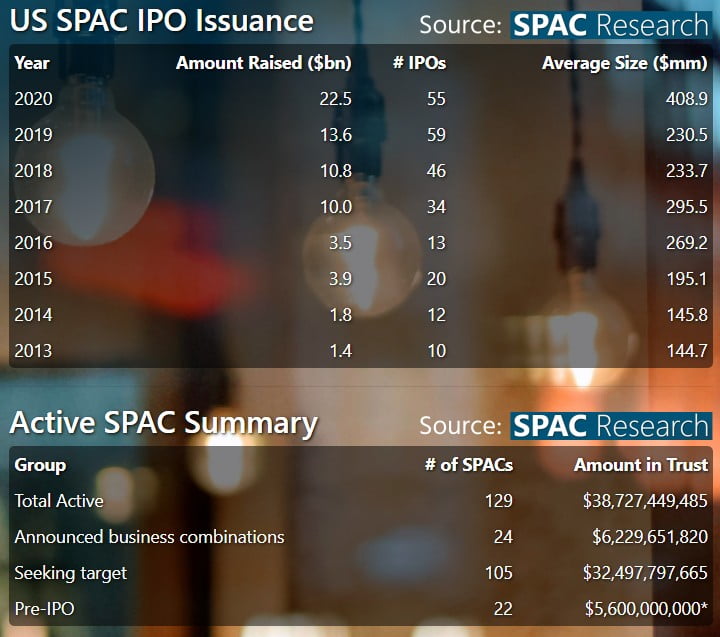
55 SPAC IPOs in the US in 2020 until the end of July – 2020 will be remembered as the year when SPACs became the new IPO.

Special Purpose Acquisition Companies are broadly attracting Private Equity during the pre-IPO stage, due to SPACs’ clear and short-term exit strategy and potentially high gains.

SPAC-IPOs
The Drivers for SPACs’ Surge

Failing quantitative easing policies, negative or extremely low interest policies, political global uncertainty, extended market uncertainty, and finally COVID-19 were the main drivers for the incredible surge of SPACs in 2020, an incredible surge, both in numbers of SPAC IPOs and size of SPAC IPO proceeds.

While 2018 with 46, and 2019 with 59 SPAC IPOs have already been very good years for SPACs, 2020 is the year of the real break-through of SPACs. It is the year where SPACs established themselves as a widely recognised alternative for pre-IPO Private Equity Investors, large institutional IPO investors, and for private companies as an alternative and preferred way to get public.

SPACs in 2020 – Figures

In addition, the 55 SPAC IPOs this year, there are additional 22 SPACs filed with the S.E.C. Once approved, they will do their IPOs.

As SPAC consultants, we are having hard time to keep our postings and information updated, so fast are the developments on the SPAC market. The current status of US SPACs, as per today, 30th of July 2020, is breathtaking.

There are currently 129 active US-listed SPACs in total. If we deduct the number of SPAC IPOs in 2020, 74 of the active SPACs had their IPO in 2019 or 2018. 20 of those 74 SPACs will expire this year unless they consummate a business combination (acquisition) prior to their deadline,

Of the 129 currently active SPACs, 24 announced a business combination (acquisition). 109 SPACs are currently seeking acquisition targets. Those SPACs seeking targets have a total of $32,5 billion cash on trust account, which translates to acquisitions expected in the range of roughly $97,5 – $130 billion.

The above information is based on the excellent statistical work of SPAC Research.

SPAC Consultants: Our holistic approach to SPACs

As experienced SPAC consultants or SPAC advisors, we provide our SPAC advisory and project management services to different group of clients related to SPACs.

Our SPAC consulting and project management services are tailor-made for private equity investors who wish to invest in their own SPAC on the pre-IPO stage as so-called SPAC Sponsors, or who prefer to sponsor an existing SPAC project at its pre-IPO stage.

As SPAC consultants, we are designing and structuring SPACs, arranging for S.E.C. approval and listing at Nasdaq or NYSE, organising pre-IPO roadshows, arrange for IPOs and assist in finding acquisition targets as per a SPAC’s acquisition strategy. Our SPAC consultants and advisers are well experienced on all stages and aspects of SPACs.

If you are interested in setting up a SPAC or in participating in an existing SPAC on its pre-IPO stage, we will be happy to arrange an initial Zoom conference to get acquainted, to further elaborate on SPACs and their manifold opportunities, and to discuss with you your SPAC investment and business ideas.